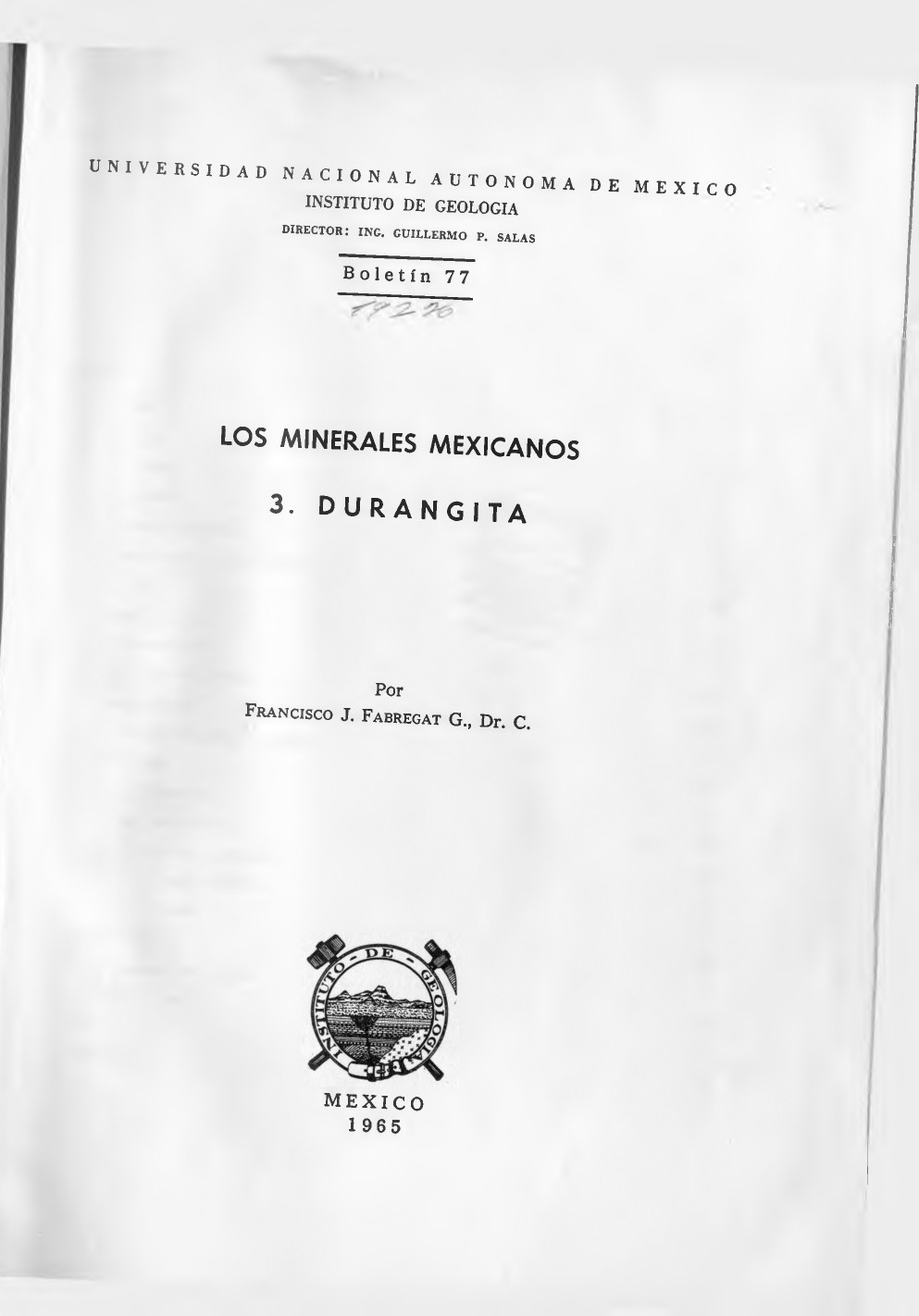
The Mexican Minerals 3: Durangite
DOI:
https://doi.org/10.22201/10.22201/igl.01855530e.1965.77.95Keywords:
Durango, monoclinic habit, cationic, Portillos mineAbstract
Among the mineral species discovered in Mexico, DURANGITE is one of the most well-defined and holds key importance in mineralogical systematics. It is an isomorphous-isotypical fluoro-arsenate within the titanite group.
As a mineral discovered in the third quarter of the last century, it was the subject of a conscientious chemical study, although its crystallographic investigation was treated lightly. Its first description was made by leafing through Dana's System of Mineralogy to see which figure it resembled. The advantage of this rudimentary search was that it later piqued Strunz's interest to more closely examine its presumed isomorphism.
Despite Des Cloizeaux's crystallometric determinations being only approximations, they were axiomatically accepted by mineralogists; based on these, an Athenian author (Kokkoros) determined its structure.
Upon synthesizing the crystals, Machatschki (1941) found certain morphological and parametric differences compared to those published until then regarding natural durangite. He verified that his artificial crystals, which exhibited prismatic and tabular habits, did not have identical lattice constants to those of the type-durangite, whose habit is predominantly dipyramidal.
Determinations of the optical constants posed an enigma that has gone unnoticed due to a lack of thorough consideration: this crystal, measured as monoclinic, exhibits triclinic optical behavior.
A doubt arises that must be resolved later: whether a dimorphism within the species corresponds to the differences in habit, or if the duality of its dimensions simply obeys the degree of isomorphous cationic substitution.
This double series of dimensions noted by Machatschki between natural and artificial crystals was confirmed in our natural sample—divergences that necessitated an inquiry into analytical demonstrations. The discovery of the triclinic character (albeit slight) of durangite crystals fully confirms its optical properties.
This critical revision does not intend to impose a radical or definitive solution to the problem, but only to present its current state and offer an analytical assessment of the facts, leaving the reader free to establish the decision they deem most congruent.
Abstract from:
Gómez-Caballero, J. A. (2005). Historia e índice comentado del Boletín del Instituto de Geología de la UNAM. Boletín de la Sociedad Geológica Mexicana: Volumen Conmemorativo del Centenario Aspectos históricos de la Geología Mexicana, 57I(2), 149-185. http://dx.doi.org/10.18268/BSGM2005v57n2a3
References
• Aguilera, J. G. (1898). Catálogos Sistemáticos y Geográficos de las Especies Mineralógicas de la República Mexicana. Instituto Geológico de México, Boletín 11.
• Brush, G. J. (1869). Contributions from the Sheffield Laboratory of Yale College. No. XX. On Durangite, a fluo-arsenate from Durango in Mexico. American Journal of Science (II), 48(143), 179-182.
• Dana, J. D. (1892). System of Mineralogy (6ª ed., p. 780). New York.
• Dana (1957). Véase Palache, Berman, & Frondel (1957).
• Des Cloizeaux, M. (1875). Note sur la forme cristalline et sur les propriétés optiques de la durangite. Annales de Chimie et de Physique, 4, 401-406.
• Des Cloizeaux, M. (1877). Notas sobre la forma cristalina y las propiedades ópticas de la Durangita. La Naturaleza, Sociedad Mexicana de Historia Natural, 4(1877-1879), 44-47. Annales de Chimie et de Physique, 4, 401-406.
• Goldschmidt, V. (1886). Index der Krystallformen der Mineralien (Vol. I, p. 519). Berlín: Springer.
• Groth, P. (1908). Chemische Krystallographie (Vol. II, p. 845). Leipzig.
• Hintze, C. (1933). Handbuch der Mineralogie (Vol. I, Parte 49, Primera Mitad, p. 631). Berlín y Leipzig: Walter de Gruyter.
• Johnston, R. A. A. (1907). Mineralogical notes. Geological Survey, Department of Mines, Canada, Summary Report, 7, 96. Groth’s Zeitschrift, 46, 619.
• Klockmann, F., & Ramdohr, P. (1945). Tratado de Mineralogía (Versión F. Pardillo, p. 524). Barcelona: Gili.
• Kokkoros, P. (1937). Über die Gitterkonstanten und die Raumgruppe von Durangit. Naturwissenschaften, 25, 717. Strukturbericht, 5, 95.
• Kokkoros, P. (1938). Über die Struktur des Durangit NaAlF(AsO₄). Zeitschrift für Kristallographie (A), 99, 38-49. Strukturbericht, 6, 110.
• Larsen, E. S. (1921). The Microscopic Determination of the Nonopaque Minerals (p. 70, 19ª ed.). U.S. Geological Survey, Bulletin 679. (29ª ed. con Berman, U.S. Geological Survey, Bulletin 848, 1934).
• Machatschki, F. (1941). A synthesis des Durangites NaAlF[AsO₄]. Zeitschrift für Kristallographie, 103, 221-227.
• Palache, C., Berman, H., & Frondel, C. (1957). Dana's System of Mineralogy (Vol. II, pp. 827-829). New York: Wiley.
• Porter, M. W., & Spiller, R. C. (1956). The Barker Index of Crystals (Vol. II, Part 2, No. 823). Cambridge: Heffer.
• Salazar Salinas, L. (1928). Elementos de Geología (No. 558, p. 161). México: Talleres Gráficos.
• Smith, W. C., Guiza, R., & Segerstrom, K. (1950). Tin deposits of Durango, Mexico. U.S. Geological Survey Bulletin, 962-D.
• Smith, W. C., Guiza, R., & Segerstrom, K. (1957). Los yacimientos de estaño en el Estado de Durango. Instituto Nacional de Investigaciones de Recursos Minerales, Boletín, 36. También en U.S. Geological Survey Bulletin, 962-D.
• Strunz, H. (1935). Mineralien der Descloizitgruppe: Konichalzit, Stassizit, Austinit, Duftit, Aráoxen, Volbortit, Pyrobelonit. Zeitschrift für Kristallographie (A), 101, 496-506. Naturwissenschaften, 27, 423. Strukturbericht, 7, 151.
• Strunz, H. (1938). Isomorphie zwischen Tilasit, Durangit und Cryophilit. Zentralblatt für Mineralogie, Geologie und Paläontologie (A), 1938, 59-60. Strukturbericht, 6.
• Strunz, H. (1949). Mineralogische Tabellen (p. 164). Leipzig: Akademische Verlagsgesellschaft.
Downloads
Published
Issue
Section
License
Copyright (c) 2025 Boletín del Instituto de Geología

This work is licensed under a Creative Commons Attribution-NonCommercial-NoDerivatives 4.0 International License.