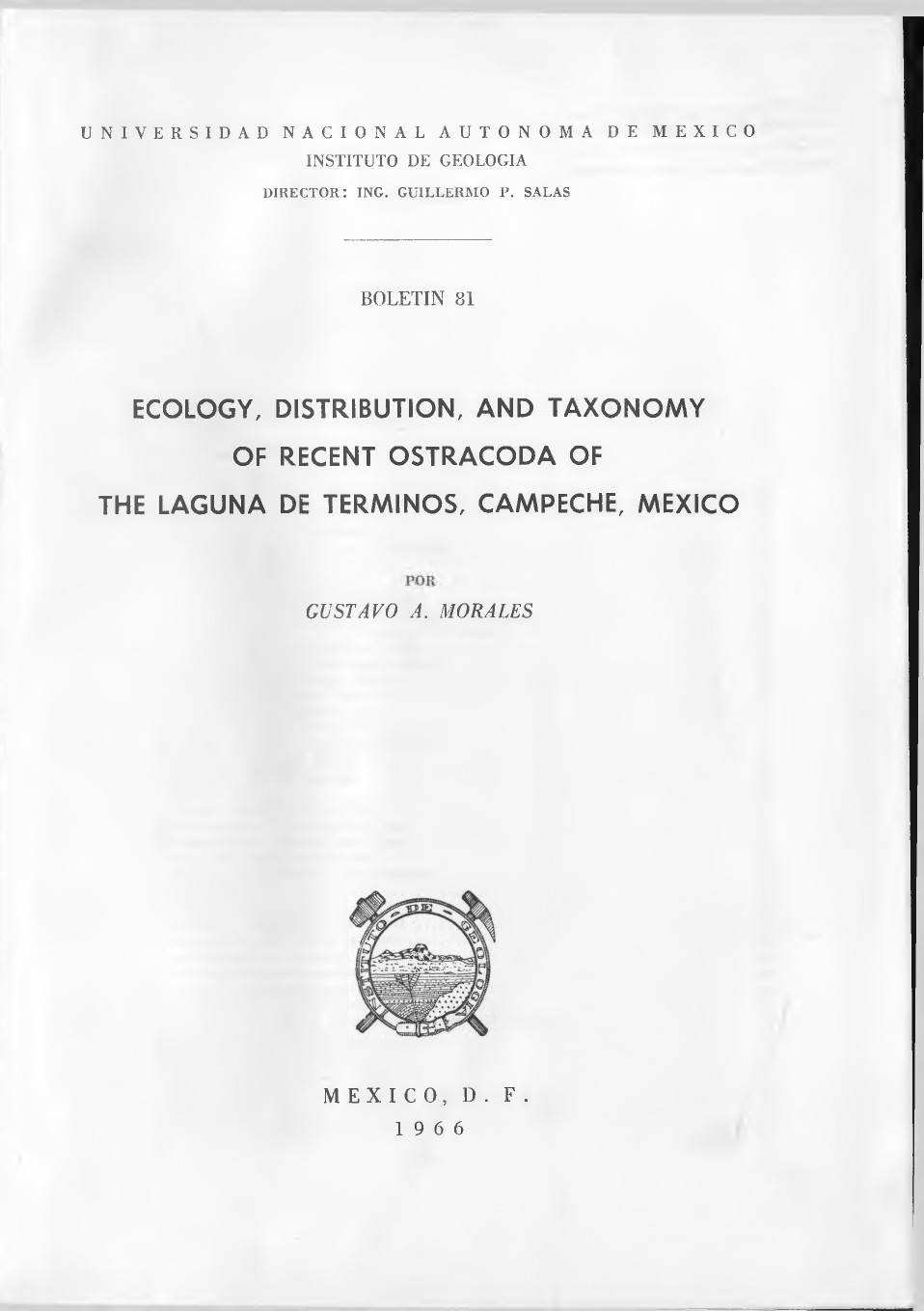
Ecología, distribución y taxonomía de los Ostracoda recientes de la Laguna de Términos, Campeche, México
DOI:
https://doi.org/10.22201/10.22201/igl.01855530e.1966.81.99Palabras clave:
especies eurihalinas, banco de ostiones, paleoecología, Acdnocythereis triangularis, Leptocythere nikraveshaeResumen
Treinta y nueve especies de ostrácodos Recientes, que representan veintidós géneros, han sido reconocidas en la Laguna de Términos, Campeche, México. Cinco de estas especies son
nuevas: Acdnocythereis triangularis, Leptocythere nikraveshae, Pumilocytheridea ayalai, Xestoleberis rigbyi y Cytherura sandbergi.
Debido a la gran variación en la salinidad del agua, la fauna de ostrácodos está compuesta en su mayoría de especies eurihalinas; sin embargo tres grupos más o menos bien definidos caracterizan (1) el banco de ostiones, (2) la laguna y (3) el delta submarino del interior de la laguna. Con la información disponible no es posible el evaluar con seguridad el efecto que la vegetación sumergida y la turbidez del agua puedan tener en la distribución y abundancia de los ostrácodos. Cerca de la mitad de los ostrácodos colectados en la Laguna de Términos fueron encontrados en Jas estaciones alrededor del contacto de la zona de agua clara con vegetación sumergida y la zona de agua turbia sin vegetación. El ambiente más propicio para el desarrollo de los ostrácodos parece ser el resultado de la combinación de las plantas sumergidas y los materiales nutritivos que son acarreados por los ríos en la parte oeste de la laguna. Se ha confirmado que los requisitos ecológicos varían considerablemente de una a otra especie dentro del mismo género y que el uso de un solo género como indicador de ambiente en trabajos paleocológicos puede resultar en errores.
Citas
• Ayala-Castañares, A. (1963). Sistemática y distribución de los foraminíferos recientes de la Laguna de Términos, Campeche, México. Universidad Nacional Autónoma de México, Instituto Geológico, Boletín, 67(pt. 3), 130 p., 60 figs., 12 pls.
• Benson, R. H. (1959). Ecology of recent ostracodes of the Todos Santos Bay region, Baja California, Mexico. University of Kansas Paleontological Contributions, Arthropoda, 1, 80 p., 11 pls., 20 figs.
• Benson, R. H., & Coleman, G. L., III. (1963). Recent marine ostracodes from the eastern Gulf of Mexico. University of Kansas Paleontological Contributions, Arthropoda, 2, 52 p., 8 pls., 33 figs.
• Benson, R. H., & Kaesler, R. L. (1963). Recent marine and lagoonal ostracodes from the Estero de Tastiota region, Sonora, Mexico (northeastern Gulf of California). University of Kansas Paleontological Contributions, Arthropoda, 3, 1–34, pls. 1–4, figs. 1–20.
• Bernatowics, A. J. (1952). Marine monocotyledonous plants of Bermuda. Bulletin of Marine Science of the Gulf and Caribbean, 2, 338–345.
• Bold, W. A. van den. (1946). Contribution to the study of ostracodes with special reference to the Tertiary and Cretaceous microfauna of the Caribbean region. (Doctoral dissertation). University of Utrecht, J. H. De Bussy, Amsterdam, 167 p., 18 pls.
• Bold, W. A. van den. (1950). Miocene ostracoda from Venezuela. Journal of Paleontology, 24(1), 76–88.
• Bold, W. A. van den. (1957). Oligo-Miocene ostracoda from southern Trinidad. Micropaleontology, 3(3), 231–254, pls. 1–4, 2 figs.
• Bold, W. A. van den. (1958a). Distribution of freshwater ostracodes in Trinidad. Micropaleontology, 4(1), 71–74, figs. 1–3, tables 1–5.
• Bold, W. A. van den. (1958b). Ostracoda of the Brasso Formation of Trinidad. Micropaleontology, 4(4), 391–418, pls. 1–5, 1 table.
• Bold, W. A. van den. (1963a). The ostracode genus Orionina and its species. Journal of Paleontology, 37(1), 33–50, pls. 3–4, 6 figs.
• Bold, W. A. van den. (1963b). Upper Miocene and Pliocene ostracoda of Trinidad. Micropaleontology, 9(4), 361–424, pls. 1–12, 7 tables, 5 figs.
• Bosquet, J. A. H. (1852). Descriptions des entomostraces fossiles des terrains tertiaires de la France et de la Belgique. Académie Royale des Sciences, Lettres et Beaux-Arts de Belgique, Mémoires Couronnés (Brussels), 24, 142 p., 6 pls.
• Brady, G. S. (1867-1871). Descriptions of ostracoda. In L. De Folin & L. Perier (Eds.), Les Fonds de la Mer, 1, 316 p., 32 pls.
• Brady, G. S. (1868). A monograph of the recent British ostracoda. Transactions of the Linnean Society of London, 26, 353–495, pls. 23–41.
• (1880). Report on the ostracoda dredged by H.M.S. Challenger during the years 1873-1876. Reports of the Scientific Results of the Voyage of H.M.S. Challenger, Zoology, 1(pt. 3), 1–184, pls. 1–44.
• Brown, P. M. (1958). Well logs from the Coastal Plain of North Carolina. North Carolina Department of Conservation and Development, Bulletin, 72, 1–99, pls. 1–8, figs. 1–9.
• Byrne, J. V., LeRoy, D. O., & Riley, C. M. (1959). The chenier plain and its stratigraphy, Southwestern Louisiana. Transactions of the Gulf Coast Association of Geological Societies, 9, 237–259, 6 pls., 9 figs.
• Chapman, F., & Crespin, I. (1928). In F. Chapman, L. Crespin, & R. A. Keble (Eds.), The Sorrento Bore, Mornington Peninsula, with a description of new or little known fossils. Records of the Victoria Geological Survey, 5(pt. 1), 1–195, pls. 1–12.
• Curtis, D. M. (1960). Relation of environmental energy levels and ostracode biofacies in East Mississippi Delta area. Bulletin of the American Association of Petroleum Geologists, 44(4), 471–494, 3 pls., 17 figs., 1 table.
• Drooger, C. W., & Kaasschieter, J. P. H. (1958). Foraminifera of the Orinoco-Trinidad-Paria shelf. Reports of the Orinoco Shelf Expedition, 4, Eerste Reeks, 22, 1–108, 41 maps, 5 pls.
• Edwards, R. A. (1944). Ostracoda from the Duplin Marl (Upper Miocene) of North Carolina. Journal of Paleontology, 18(6), 505–528, pls. 85–88.
• Egger, J. G. (1901). Ostracoda from sea bottom samples dredged in 1874-1876 by S.M.S. Gazelle. Königlich Bayerische Akademie der Wissenschaften, Mathematisch-Physikalische Klasse, Abhandlungen, 21(pt. 2).
• Emery, K. O., & Stevenson, R. E. (1957). Estuaries and lagoons. I. Physical and chemical characteristics. In Treatise on Marine Ecology and Paleoecology (Vol. 1, p. 673–693). Geological Society of America, Memoir 67, Ecology, figs. 1–11.
• Garcia-Cubas, A. (1891). Diccionario geográfico, histórico y bibliográfico de los Estados Unidos Mexicanos (Vol. 5, 564 p.). Oficina Tipográfica Secretaría de Fomento, México.
• García-Cubas, A., Jr. (1963). Sistemática y distribución de los micromoluscos de la Laguna de Términos, Campeche, México. Universidad Nacional Autónoma de México, Instituto Geológico, Boletín, 67(pt. 4), 55 p., 4 pls., 24 figs.
• Ginsburg, R. N., & Lowenstam, H. A. (1956). Influence of marine bottom communities on the depositional environments of sediments. Congrès Géologique International, XX Session, Mexico, 1956. Resumenes de los trabajos presentados, 232.
• Ginsburg, R. N., & Lowenstam, H. A. (1958). The influence of marine bottom communities on the depositional environment of sediments. Journal of Geology, 66(3), 310–318, pls. 1–2, 5 figs.
• Grossman, S. (1965). Morphology and ecology of two podocopid ostracodes from Redfish Bay, Texas. Micropaleontology, 11(2), 141–150, pls. 1–2.
• Hanai, T. (1957a). Studies on the ostracoda from Japan, I. Subfamily Leptocytherinae, New Subfamily. Journal of the Faculty of Science, Tokyo University, Section 2, 10, 431–468, pls. 7–10.
• Hanai, T. (1957b). Studies on ostracoda from Japan, III. Subfamilies Cytherurinae G. W. Muller (emend. G. O. Sars 1925) and Cytheropteroninae, New Subfamily. Journal of the Faculty of Science, Tokyo University, Section 2, 11(pt. 1), 11–36, pls. 2–4.
• Hanai, T. (1959a). Studies on the ostracoda from Japan, IV. Family Cytherideidae Sars 1925. Journal of the Faculty of Science, Tokyo University, Section 2, 11(pt. 3), 291–308, pls. 16–18.
• Hanai, T. (1959b). Studies on the ostracoda from Japan, V. Subfamily Cytherinae Dana, 1852 (emend.). Journal of the Faculty of Science, Tokyo University, Section 2, 11(pt. 5), 409–418, pl. 28.
• Hanna, M. A. (1954). A simple coring tube for soft sediments. Journal of Sedimentary Petrology, 24(4), 263–269, pls. 1–2.
• Hartmann, G. (1957a). Zur Kenntnis des Mangrove-Ester o-Gebietes von El Salvador und seiner Ostracoden-Fauna. II. Universität Kiel, Kieler Meeresforschung, 13(1), 134–159, pls. 39–50.
• Hartmann, G. (1957b). Contribución al conocimiento de la región de esteros y manglares de El Salvador y su fauna de ostrácodos. Comunicaciones del Instituto de Investigaciones Científicas del Tropico, Universidad de El Salvador, 3-4, 48–108, pls. 39–50.
• Hedgpeth, J. W. (1957a). Classification of marine environments. In Treatise on Marine Ecology and Paleoecology (Vol. 1, p. 17–27). Geological Society of America, Memoir 67, Ecology, 5 figs.
• Hedgpeth, J. W. (1957b). Obtaining ecologic data in the sea. In Treatise on Marine Ecology and Paleoecology (Vol. 1, p. 53–86). Geological Society of America, Memoir 67, Ecology.
• Hedgpeth, J. W. (1957c). Estuaries and lagoons. II. Biological aspects. In Treatise on Marine Ecology and Paleoecology (Vol. 1, p. 693–729). Geological Society of America, Memoir 67, Ecology, figs. 12–30.
• Hernandez, J. (1923). The temperature of Mexico. United States Department of Agriculture, Weather Bureau Monthly Weather Review, Supplement, 23, 24 p., 75 figs.
• Hornibrook, N. de B. (1952a). History of the living marine ostracode fauna of New Zealand — A quantitative analysis. The Micropaleontologist, 6(3), 20–22.
• Hornibrook, N. de B. (1925b). Tertiary and recent marine ostracoda of New Zealand. New Zealand Geological Survey, Paleontological Bulletin, 18, 82 p., 18 pls.
• Hoskin, C. M. (1962). Recent carbonate sedimentation on Alacran Reef, Yucatan, Mexico. National Research Council, Division of Earth Science. Foreign Field Research Program, Report 19, 160 p., 22 pls., 24 figs., 36 tables.
• Howe, H. V., et al. (1935). Ostracoda of the Area Zone of the Choctawhatchee Miocene of Florida. Florida Geological Survey, Bulletin, 13, 1–37, pls. 1–4.
• Howe, H. V., & Chambers, J. (1935). Louisiana Jackson Eocene ostracoda. Louisiana Department of Conservation, Geological Bulletin, 5, 1–65, pls. 1–6.
• Kesling, R. V. (1951). The morphology of ostracode molt stages. Illinois Biological Monographs, 21(1–3), 324 p.
• Keij, A. J. [or Key, A. J.]. (1954a). Ostracoda. Identification and description of species. In T. van Andel & H. Postma (Eds.), Recent sediments of the Gulf of Paria. Reports of the Orinoco Shelf Expedition, 1, Koninklijke Nederlandse Akademie van Wetenschappen, Afdeling Natuurkunde, Verhandelingen, 1(20)(5), 119–128, 218–231, pls. 3–6.
• Keij, A. J. [or Key, A. J.]. (1954b). Some recent ostracoda of Manila (Philippines). Koninklijke Nederlandse Akademie van Wetenschappen, Series B, 57, 351–363, 3 pls., 2 figs.
• Kingma, J. T. (1948). Contributions to the knowledge of the Young-Caenozoic ostracoda from the Malayan region. Dissertation, University of Utrecht, 1–118, pls. 1–11.
• Kornicker, L. S. (1963). Ecology and classification of Bahamian Cytherellidae (Ostracoda). Micropaleontology, 9(1), 61–70, 44 figs., 4 tables.
• Kornicker, L. S., & Wise, C. D. (1960). Some environmental boundaries of a marine ostracode. Micropaleontology, 6(4), 393–398, figs. 1–8.
• Ladd, H. S. (1951). Brackish-water and marine assemblages of the Texas Coast, with special reference to mollusks. Publications of the Institute of Marine Science, 2(1), 125–163, 1 map, 1 table.
• Lankford, R. R. (1959). Distribution and ecology of Foraminifera from East Mississippi Delta Margin. Bulletin of the American Association of Petroleum Geologists, 43(9), 2068–2099, 3 pls., 11 figs.
• Lowman, S. W. (1949). Sedimentary facies in Gulf Coast. Bulletin of the American Association of Petroleum Geologists, 33(12), 1939–1997, 35 figs.
• Malkin, D. S. (1953). Biostratigraphic study of Miocene Ostracoda of New Jersey, Maryland, and Virginia. Journal of Paleontology, 27, 761–799, pls. 78–82, 14 figs.
• McLean, J. D., Jr. (1957). The Ostracoda of the Yorktown Formation in the York-James Peninsula of Virginia. Bulletin of the American Paleontological Society, 38(167), 57–103, pls. 7–12.
• Mincher, A. R. (1941). The fauna of the Pascagoula Formation. Journal of Paleontology, 15(4), 337–348, pls. 46–47.
• Müller, G. W. (1894). Die Ostracoden des Golfes von Neapel und der angrenzenden Meeres-Abschnitte. Fauna und Flora des Golfes von Neapel, 21, 404 p., 40 pls., 13 figs.
• Parker, R. H. (1955). Changes in the invertebrate fauna, apparently attributable to salinity changes, in the bays of Central Texas. Journal of Paleontology, 29(2), 193–211, 8 figs., 2 tables.
• Parker, R. H. (1956). Macro-invertebrate assemblages as indicators of sedimentary environments in East Mississippi Delta Region. Bulletin of the American Association of Petroleum Geologists, 40(2), 295–376, 9 pls., 32 figs.
• Phleger, F. B. (1954). Ecology of Foraminifera and associated microorganisms from Mississippi Sound and environs. Bulletin of the American Association of Petroleum Geologists, 38(4), 584–647, pls. 1–3, figs. 1–28, tables 1–11.
• Phleger, F. B. (1960). Sedimentary patterns of microfaunas in the northern Gulf of Mexico. In Recent sediments, northwest Gulf of Mexico (pp. 267–381). American Association of Petroleum Geologists, Symposium, 6 pls., 16 figs.
• Pokorny, V. (1955). Contribution to the morphology and taxonomy of the subfamily Hemicytherinae Puri. Acta Universitatis Carolinae III, Geologica, 3–34, 19 text-figs.
• Pokorny, V. (1964). The taxonomic delimitation of the subfamilies Trachyleberidinae and Hemicytherinae (Ostracoda, Crustacea). Acta Universitatis Carolinae, Geologica, 3, 275–284.
• Puri, H. S. (1952). Ostracode genera Cytheretta and Paracytheretta in America. Journal of Paleontology, 26(2), 199–212, pls. 39–40, 16 figs., 1 table, 2 charts.
• Puri, H. S. (1952). Ostracode genus Cytherideis and its allies. Journal of Paleontology, 26(6), 902–914, pls. 130–131, 14 figs., 1 table, 1 chart.
• Puri, H. S. (1953a). The ostracode genus Trachyleberis and its ally Actinocythereis. American Midland Naturalist, 49, 171–187.
• Puri, H. S. (1953b). The ostracode genus Hemicythere and its allies. Journal of the Washington Academy of Sciences, 43(6
Descargas
Publicado
Número
Sección
Licencia
Derechos de autor 2025 Boletín del Instituto de Geología

Esta obra está bajo una licencia internacional Creative Commons Atribución-NoComercial-SinDerivadas 4.0.